
First Strides - North Myrtle Beach Workshop
When is First Strides - North Myrtle Beach Workshop?
First Strides - North Myrtle Beach Workshop takes place on Thursday, February 26, 2026 in Little River, SC.
What distances does First Strides - North Myrtle Beach Workshop offer?
First Strides - North Myrtle Beach Workshop offers 1 event: First Strides NMB Workshop.
| Event | Distance | Price | |
|---|---|---|---|
| First Strides NMB Workshop | 3.12 mi | $40.00 | Register |
How much does First Strides - North Myrtle Beach Workshop cost?
Registration for First Strides - North Myrtle Beach Workshop starts at $40.00.
Where is First Strides - North Myrtle Beach Workshop held?
First Strides - North Myrtle Beach Workshop is held in Little River, SC at North Myrtle Beach Park & Sports Complex - Amphitheater.
About First Strides - North Myrtle Beach Workshop
FIRST STRIDES NMB
Beginner Walking & Running Workshop for Women
SPRING & FALL SESSIONS ANNUALLY
Do you sometimes imagine yourself fit and strong, striding comfortably down the road during an easy workout or maybe even a 5K event? You know being more active makes you healthier, but you may not know how to get started?
This gradual program will help you comfortably progress to walking, jogging, running or some combination at a pace that's right for you. The program accommodates all paces. It is all self paced. You are grouped according to your striding ability and preference…walkers are grouped together, joggers/runners are grouped together.
The program is designed for you and you’ll fit right in!
WHEN:
Spring 2026 Workshop: Workshops meet from 5:30 - 6:45 p.m, rain or shine, on the following dates…
NEW! Thursday, February 26 - Orientation for new striders (everyone welcome to participate but this workshop date is intended to introduce new striders to the program in advance of the 11 week program).
11 Week Program - Thursday, March 5 through Thursday, May 14.
We encourage you to sign up early!
LOCATION:
North Myrtle Beach Park & Sports Complex - Amphitheater (SW corner of Route 31 and Robert Edge Parkway) Address: 150 Citizen's Circle, Little River, SC
FOR WHOM:
Women 12 to 112 years of all shapes, sizes and abilities. This is a BEGINNER walking program…no experience necessary! Bring your daughters, mothers, neighbors, co-workers, friends or come solo. No pets or children under 12 years of age.
FORMAT:
Weekly workshops include stretching, a group walk/jog/run, and a brief discussion of various topics relevant to walking/running (e.g., proper shoes, injury prevention, safety, health, nutrition and more). Come dressed for activity and the weather.
Weekly Schedule
Check in...for attendance credit
Speaker/Topic
Mentor Introduction
Announcements
Group Pre-Stretch
Walk/jog/run Workout
Group Post-Stretch
Final Announcements
Homework: 2 additional weekly workouts on your own time
COMMUNICATIONS:
We communicate with participants in two ways: 1) email, using the email you registered with; and 2) Facebook, First Strides - North Myrtle Beach, registrants can join this private FB page.
GOAL:
All who complete this program will be able to participate in and complete a private 5K WALK / RUN (3.1 miles) scheduled for Week #11.
MENTORS:
Area walking and running enthusiasts from the Grand Strand Running Club (GSRC) and others volunteer their time to lead and support your progress!
COST:
$40 until 11:59 pm on Thursday, February 26th (one week before the 11 week workshop commences).
$45 until 11:59 pm on Thursday, March 12th (Week #2 of the 11 week workshop).
Fee includes weekly workshops including instruction, group walk/run workout, mentors, literature, the 5K Walk/Run event and a First Strides NMB tee shirt. Workshop fee is non-refundable and non-transferable.
WHAT IS FIRST STRIDES?
The First Strides program was founded in 1997 in Allentown, PA by Jane Serues. It still continues there today with over 8000 women participating. First Strides was conceived as a way to get women off the couch and doing a walking routine they could do for the rest of their life. In 2001, First Strides was recognized with a national award by Road Runners Club of America and has the highest graduation rate of any beginner program.
In 2019, Jane introduced the program in North Myrtle Beach, co-presented by the Grand Strand Running Club and the City of North Myrtle Beach. The Fall 2019 First Strides NMB workshop attracted over 170 females. Since then, workshops have been held Spring and Fall. First Strides NMB is here to stay thanks to the support of our sponsors, especially the Grand Strand Running Club, and our wonderful volunteer mentors!
Basic Etiquette Rules for Striding


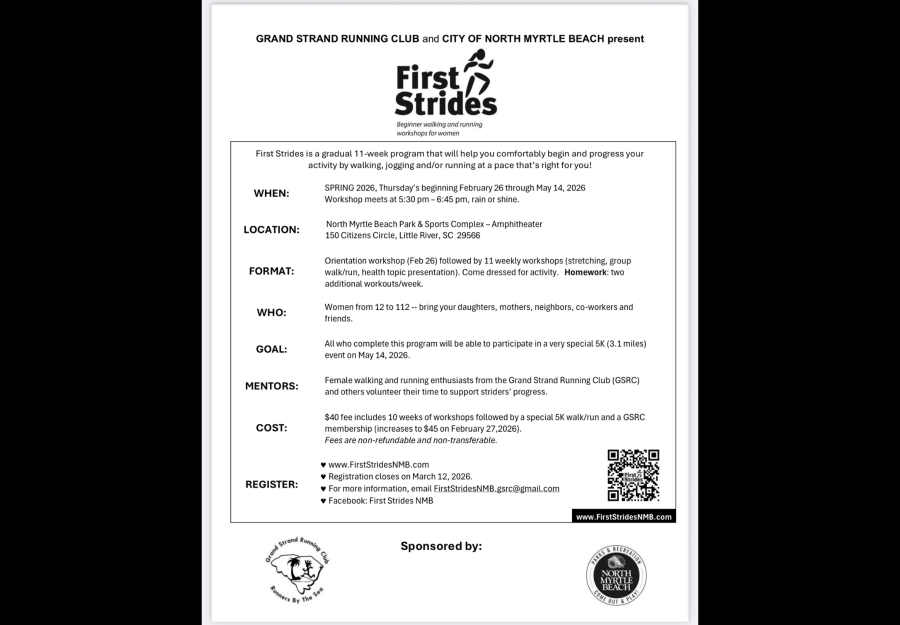
First Strides NMB Flyer
Gallery
Getting Better
Getting Better
Once you have a base ... getting better is a matter of gradually increasing the stress. Remember:
Stress + Rest = Improvement
1. ADD DISTANCE or MINUTES: RULE OF THUMB: Never increase your mileage by more than approximately 10% per week. Example: Say you’re doing 3 miles 3 times per week or 9 miles/week. The next week you shouldn't do more than 10 miles in total. You can do that by adding 1 mile to 1 of your (3) 3-mile workouts. (3 miles 2 days and 4 miles one day). Or, you could run/walk 3 miles one day and 3 ½ miles the other 2 days.
2. ADD FREQUENCY: Walk/Run 4 days/week instead of 3. Or work up to 6 days/week Intersperse rest days in between.
3. ADD SPEED: Choose one day a week to go at a quicker pace (with an easy warmup and cool down). That includes entering a race, speed workouts, time trials ... these all qualify. Then be sure to take it very easy on your recovery days. Never put 2 speed days back to back. Spread them out throughout the week.
4. ADD DIFFICULTY: In addition to the examples above, difficulty can include hills or hilly courses, grass (like cross country courses), sand (loose sand is VERY difficult ... go a short distance only!), etc.
5. MIX IT UP: Don't do the same workout every day at the same pace. You will maintain your fitness, but you won't improve. If you average 3 mi/day; go 4 mi. one day and 2 mi. another.
IMPORTANT: Don't add all of these changes at once. You should introduce new elements to your training one (maybe two) at a time. Example: Don't jump your mileage up by 5 miles/week and start doing speed work 2 days/week all in the same week. You are asking for injury if you ignore this common-sense principle.
SPEEDWORK (examples):
§ Races - start with 5Ks. Then set a goal 3+ months out to walk/run a 5 miler or 10K. Increase distance gradually.
§ First, learn to pace yourself so your first mile isn't faster than your last. THEN, work on getting that pace down a few seconds per mile. Learning pace is the toughest lesson!!!
§ You can usually race distances up to 2-3 times your average weekly workout ... but it won't be fun! Better to train up to the distance. Example: walk/run 6 miles at least once a week before you race 10K.
§ Distance intervals - use a track to alternate hard running/power walk with jogging/walking. Examples:
§ Push the straight-aways, easy pace the curves.
§ Pickup/hard 1/2 lap, recovery pace 1/2 lap.
§ Alternate full lap pickup; jog/walk easy 1/2 lap.
§ Push pace 1/2 lap, easy/recovery pace 1/2 lap, run a full lap, jog 1/2 lap, run 2 laps, jog full lap (this is called a ladder). Then repeat.
§ The same concept can be done off the track using city blocks or telephone poles or driveways, etc.
§ Timed intervals - use your watch. This is what we’ve been doing in First Strides NMB!
§ Pickup 30 sec, easy/recovery 30 sec. Continue this pattern for the middle 10 minutes of your workout.
§ Run 30 sec, jog 30 sec, run 1 min, jog 30 sec, run 2 min, jog 1 min ... (see the pattern?) Use the same or 1/2 the distance/time as your recovery jog/walk.
§ Hills - intervals. The steeper the hill, the shorter the interval. Attack hills at a pace that tires you, but doesn't stop you. Then recover slowly with shorter strides on the downhill ... but don't hold back and strain your knees.
§ Time trials - if you have a course you do daily, once a week push your pace and time it to see if you can go faster. Not every day ... just once every couple of weeks. Walk/Run your course at a sustained, quicker (not sprint) pace than you normally do it.
* A “track” is usually ¼ mile/400 meters. Our NMB Meadow Loop is 0.6 miles-just over double a school loop track.
Hydration Facts
Injury Prevention
GUIDELINES FOR INJURY PREVENTION
- BEGIN SLOWLY: Start with a basic program that you are comfortable with. Consider distance, time and intensity.
- PROPER SHOES: Purchase a good pair of supportive walking or running shoes that are designed for your foot and body type. Seek out a knowledgeable sales representative at a specialty retailer). It will be well worth the effort.
- PROGRESS GRADUALLY: Progressively increase your walking or running program in a gradual manner. This means monitoring increases in pace, time and/or distance, and surface. Make advancements in 10% increments each week.
- LISTEN TO YOUR BODY: Do not try to train through a present or potential injury. Making it hurt worse does not help it get better.
- TERRAIN: Be aware of the trail or surface you are walking or running on. Watch for uneven surfaces, holes, rocks, steep slope, etc.
- WARM UP AND COOL DOWN: Properly warm up and stretch your muscles before beginning to walk or run each day. Then stretch again after your walk/run. Proper stretching is key.
- STRETCH: Focus on your hamstrings, 2 muscles in your calf, quadriceps, and inner thigh.
- CLOTHING: Dress appropriately for changing weather conditions – hot / cold / rain. Dress as though it is actually 10 degrees cooler than it actually is.
- HYDRATE: Properly hydrate your body before, during and after you exercise. Carry water with you if possible.
SYMPTOMS OF A PENDING INJURY
- Increased pain (localized or general). Pain with palpation (rubbing) of the area.
- Redness, warmth and/or swelling
- Decreased tolerance to activity with a potential impact on activities of daily living.
TREATMENT
- ICE: Apply ice or a cold pack to the area for 15-20 minutes. (Cover the skin with a thin towel to prevent an ice burn).
- BACK OFF: Reduce the duration/distance and intensity of your walking to a sub-painful level.
- REST: Take a couple of days off if needed to rest the injured area.
- STRETCH: Gently stretch the area, but not to the point of pain.
- DOCTOR: Seek medical attention if the problem persists.
- SHOES: Check your shoes for proper fit or wear. Specialty run/walk retailers can often help... Fleet Feet Myrtle Beach [7931 N King’s Hwy, MB] or Black Dog Running Co. [1600 Farrow Pkwy, MB])
COMMON INJURIES TO WATCH FOR:
GENERAL MUSCLE SORENESS – Frequently, after starting an exercise program, a person will experience general body aches and muscle soreness. This is due to the usage of muscles in a not-so-familiar manner. This discomfort is often referred to as Delayed Onset Muscle Soreness (DOMS). This pain is usually a generalized ache associated with movement. Pain that is sharp and localized in its nature could be associated with the onset of an injury. Exercise soreness should resolve itself as exercise continues and the body adapts to the increased stresses. Be cautious not to continually increase the level of intensity without rest. Give the body time to catch up. Pain that is associated with an injury will usually increase in intensity with activity. Consult a physician if injury pain does not resolve in a timely manner.
SHIN SPLINTS – This is an inflammation of the muscles that attach to the front of the shin. Pain is usually felt along a general area approximately 6 inches long on the inside portion of the shin. Stretching the calf muscles and getting support in the arch to prevent pronation are usually helpful. If the area of pain is more of a localized point tender area, consider the possibility of a stress fracture.
PAIN AROUND THE KNEE – Pain around the knee is most commonly associated with dysfunction of the knee cap (patella). Pain around the outside of the knee can be caused by rubbing of the Iliotibial band over the bottom of the femur (thigh bone). Many of these conditions are caused by muscular strength and flexibility imbalances. Poor foot positioning and inadequate arch support can also be associated with these conditions. Proper stretching of the major lower-extremity muscle groups (quads/hamstrings/calves) as well as the Iliotibial band can be helpful. It may be necessary to acquire orthotic inserts to help adequately support the foot and prevent excessive pronation during walking and running activities.
ACHILLES TENDONITIS – Inflammation of the lower calf region near the muscle’s insertion into the heel. This is commonly caused by tight calf muscles and an excessively accelerated program. Placing a heel lift in your shoe helps take tension off of the tissues. Use Ice and gentle stretching.
PLANTAR FASCIITIS – Inflammation of the plantar fascia that lies on the bottom of the foot. Pain usually runs along the bottom of the foot. It is often most noticeable upon waking in the morning and taking the first several steps. Usually will feel better when using shoes with good arch supports.
BLISTERS: Tenderness and fluid buildup under the skin resulting from friction, usually between toes due to shoes and socks rubbing against your skin. Causes include poor-fitting shoes/socks, faster pace, foot abnormalities (bunions, heel spurs, hammertoes, etc.) Use a sterile needle to pop and drain a large blister. Gently drain fluid near the hole with clean hands and bandage to keep bacteria out. Correct the cause of the rubbing. Try new socks (blister-free) or shoes, or apply lubricating cream or Second Skin.
1st Class Important Info
FIRST STRIDES® NMB - First Class Important Information
Download the attached PDF.
5K Results
Congratulations to all our 5K participants!
Click the link below to view the results:
https://runsignup.com/Race/Results/76187/#resultSetId-607051;perpage:100
Advice for Avoiding Injury


Nutrition Tips for Working Out
WHAT SHOULD I EAT BEFORE A WALKING WORKOUT?
Have a meal or snack that is balanced with carbohydrate, protein and water.
If you are eating within 1-2 hours before walking choose foods that area easily digested and will not cause you any stomach upset.
Some examples of balanced, easily digested snacks are:
Low fat yogurt with fruit and water
Ready to eat whole grain cold cereal with low fat milk and water
Oatmeal with low fat milk and a piece of fruit and water
WHAT SHOULD I EAT DURING A WALKING WORKOUT?
If walking less than 90 minutes you should have enough fuel from you regular meals to keep you walking strong for the duration. For workouts lasting over 90 minutes a snack that offers some carbohydrate may be beneficial to keep energy levels up. A snack with 20-30 grams of carbohydrate per hour over 90 minutes will offer energy to keep you going.
Some simple, easy to carry snacks include:
Fruit
Bag of baby carrots
Bag of snap peas
Granola bar
SHOULD I EAT AN ENERGY BAR DURING WALKING TRAINING?
If moderate to intense exercise lasts longer than 90 minutes, it is recommended to take in carbohydrates to keep muscles adequately fuelled. In this program, workouts will be no longer than 90 minutes. If a carbohydrate-rich meal has been eaten the night before, or if a small amount of carbohydrate has been ingested the morning of a workout (see question above), the walker should be adequately fuelled.
SHOULD I DRINK WATER OR A SPORTS DRINK DURING TRAINING?
Yes, maintaining hydration is important for optimal walking workouts. Water should be appropriate for most walkers, but in some cases, a sports drink or juice may be beneficial – for example:
If you do not like water,
If you have not eaten any carbohydrates for 2 or more hours prior to walking
If you choose to take in energy in the form of liquid rather than solid food for longer workouts.
DO I NEED TO EAT OR DRINK FOR RECOVERY AFTER A WALKING WORKOUT?
No, provided your next meal or snack is balanced with, fluids, carbohydrate and protein.
Some examples of balanced post-walking meals include:
Salmon, rice, salad and water
Chicken breast, bean salad, grilled vegetable and water
Chicken and vegetable sandwich, tomato soup and water
Yogurt with fruit and granola
FEELING TIRED DURING WORKOUTS? YOU MAY BE DEHYDRATED.
There is no benefit to over-hydrating for these sessions, but there is a definite cost to being dehydrated. The fluid balance guidelines below can help you ensure that you drink enough every day as well as during your workouts.
Copyright SportMedBC.
Participant Emails
Each week, workshop participants will receive an email providing relevant information for the upcoming Thursday workshop.
Race Strategy for 1st 5k
Race Strategy for Your First 5K
Consider your goal:
Your goal for your first race event is to do the distance – comfortably! Consider it a benchmark time from which you can watch yourself improve with consistent, progressive training.
Find your “comfortable push” pace. This would be the pace you can sustain for the entire distance. This is hard to discover as a beginning racer.
There is nothing wrong with being “competitive”! But a smart competitor controls her competitive urges and paces evenly in a race. Other less-smart participants will “come back to you” as they slow down (due to going too fast or being “too competitive” for your body’s training level). It’s a tough lesson to learn!
Pay attention to your body! If you feel your breathing increasing uncomfortably, you need to drop your pace back to be comfortable.
Pacing properly:
Run your first mile very comfortably! This is hard to do! You probably are excited/nervous and adrenaline is flowing. This frequently results in a faster pace than you are used to.
Use the mile marks to help you monitor your pace. Most races have a sign at each mile. If you have a chromo watch or app (like a stopwatch function), you can check your pace as you go. Ideally, each mile should be run at about the same pace.
Try to walk/run “negative splits”! This means that you would walk or run each mile a little faster than the previous mile. Example: An example would be to go 13-minutes at Mile 1; 12:45 at Mile 2; 12:30 at Mile 3. That would be a 12:45 pace and an example of very smart running!
You can still do your First Strides NMB weekly workout: Mentors will still blow their whistles after 1 minute (for Easy/Recovery) and 7 minutes for (Comfortable Push/Pickup). Or set your own timer.
Don’t let your competitive urge get the best of you! If you start out too fast for the pace you have been training at, you will probably find your pace will slow as the race continues. This is not as good a feeling as finishing strong!
Competition:
Being “competitive” is not a dirty word! It’s good to let that emotion push you to become better and better at anything. But, respect the physiology of how your body works. If you push harder than you’re trained to do, your body builds up Lactic Acid which slows your performance.
Pushing yourself through controlled intervals is how you train your body to go faster or farther. Remember the Training Principle: Stress + Rest = Improvement!
You will build on this base, if you continue to walk/run consistently and progressively. You have years of “improvement” ahead of you … and THAT’S FUN!!!
Finish Line:
Never kick until you can see the Finish Line! 50 yards can be a long way for a “kick”. Be sure you judge the distance!
Keep moving after your finish. Do not stop abruptly! Cool down for several minutes before standing still.
You are trained for this. Good luck! Have fun with it!
Safety

Shoe Selection & Fit - Fleet Feet Myrtle Beach
SHOE SELECTION & FIT - Fleet Feet Myrtle Beach
First Key to any fitness program – proper and well fit footwear.
Proper, length, width and volume: Length and width should absolutely be measured, but arch height and Instep height have to be considered as well.
Why evaluate your Gait? Is there instability in the arch of the foot?
Indications of tightness upstream that might cause issues down the road.
Neutral or Stability? What does it mean? Little to no instability in arch = Neutral
Some instability – moderate stability
Significant instability – full stability shoe
No hard and fast rules though.
History of pain or injury
Stature of wearer
Inserts? MaybeHelps counteract instability by guiding foot through proper gait motion
Adds structure to inside of shoe for very high arches
How are you going to use the shoe?The shoe you use when you are just starting out may change as you progress on your fitness journey.
Cushioning should be the major consideration when you are starting (or starting over) on your running and walking journey.
Buy from someone who can do the above and knows their products. If they don’t pull out some device to measure your feet, then leave and find someone who can properly fit you. Also be aware that the shoes you can find at department stores may have the same brand name on them, but they are not the same shoes. All brands make lifestyle and casual wear models for customers shopping at the department/outlet stores. These shoes are not designed for running and/or walking. They are not made of the same quality materials as true athletic shoes.
They cost $45 for a reason.
You should expect to pay around $110 - $150 for a quality pair of shoes and they should last you 350-500 miles.

Shop
First Strides NMB’s main sponsor, Grand Strand Running Club, is selling a 1/4 zip pullover with our First Strides logo for only $35.
Shop on the Grand Strand Running Club’s webpage here:
https://runsignup.com/MemberOrg/GrandStrandRunningClub2/Store
Scroll down on that page and you’ll find the First Strides: Sport-Tek® Women's Sport-Wick® Textured 1/4-Zip Pullover available in pink and blue.

Sports Bra Basics
SPORTS BRA BASICS
1. Choosing the Perfect Bra for You
Before buying a sport bra, ask yourself these questions:
- What’s my regular bra size?
- What’s my activity level?
- Do I run/walk every day, do aerobics, take a yoga class three times a week – how active am I?
- What styles do I like?
- You should select a bra that fits your size, activity level, and personal preferences.
2. Avoiding Chafing
Chafing happens because of abrasion and moisture. When you wear a bra close to your body, after an extended time, the seams tend to run against your skin and cause abrasions. Rubbing seams combined with perspiration results in painful red marks in some very sensitive areas! You can avoid chafing by choosing seamless bras. Seamless refers to bras made using a new knitting technology that reduces or eliminates seams. The bras are made of fabrics that lift moisture away from your skin and allow it to evaporate. Selecting a bra that fits right is very important. If your bra is too loose or too tight, you’ll increase your chances of chafing. Body lubricants also reduce chafing by acting as a protective barrier between your bra and your tender skin. Use it on all chafe-prone areas before every run or walk.
3. Avoiding the Uni-Boob Look
If you don’t like the one boob look you get from bras that support your breasts by means of compression, choose bras that feature molded cups, which help you maintain your shape without sacrificing support. They’re perfect for A cup women who want more shape, and A-C cups who simply hate compression sport bras. An added bonus is that because the cups are molded, there is no nipple show through.
4. Wearing One Bra, Instead of Two
If you select one bra that’s the right support and fit for your size and activity level, you won’t need to wear two. Besides, wearing two bras increases your risk of chafing and may cause you to overheat while you’re working out.
5. Measuring Yourself for a Proper Fit
You’ll need a tape measure, and a good fitting bra. With only a bra on, measure around your body, just below the breasts. This measurement should be in inches. Add 5 to that number. That is your Bra Size. Next, measure around the fullest part of your breasts. The difference between the two numbers is your cup size. One inch difference is an A, two inches a B, three inches a C, and so on. For example, if you measure 31 inches around your chest below your breasts, you’ll add 5 to that for a bra size of 36. When you measure around the fullest part of your breasts, you get 38. The difference between the 2 is 2 inches. You are a 38 B. If you’re still unsure, many store employees can help you with this process.
6. Health Problems with Unsupportive Bras
Not wearing a supportive bra can lead to breasts that bounce and hurt while you’re working out. Also, some bras can cause abrasion over your shoulders, across your chest, or along the base of your breasts. Getting a good comfortable bra is important.
7. Smaller Breasted Women and Support
Absolutely, smaller breasted women will experience discomfort if they are not wearing a bra that is supportive. The difference is that they do not require as much technology in their bra to achieve the proper level of support. They do still need a good sport bra.
8. Larger Breasted Women and Support for High Impact
If you’re a size DD cup or above, it is important to purchase a bra that gives you the amount of support you need. There are certain features incorporated into a bra to offer more support and comfort: wider straps (even padded straps help distribute the load more evenly), encapsulated cups/molded cups, more coverage across the front and back, possibly an under wire construction. The demi-tops, tanks, and halters would not be recommended. Please refer to our handout “Clothing for Larger Sizes” for more information.
9. Shopping Test/Tips for Support
First, do a “bounce test” for motion control and comfort. By walking/running in place, or bouncing up and down, you will quickly learn if the bra is supportive enough for your needs. Buy from reputable companies that offer a good guarantee. If the bra has adjustable straps, make sure to adjust them for customized fit (this can make a big difference in the fit, comfort, support, and control of the bra). The biggest mistake most women make is having the straps too loose. Of course, be sure not to make them so tight that they pinch or dig.
10. Average Price for a Sports Bra
The cost of a good sports bra can be anywhere from $35 to $70 or more. We believe the old adage “you pay for what you get” applies to most bras. Do not base your decision on price, but on the other essential features we mentioned above. SPORT BRAS MAY BE EXPENSIVE, BUT THEY ARE ABSOLUTELY NECESSARY!
11. Average Life Span and Replacement of a Sports Bra
The life span depends on the wash, care, and frequency of usage. We highly recommend not using a dryer as this may cause some of the fabrics to break down. It is time to replace the bra when it loses elasticity and support. Some bras will also gain an odor over time.
WEBSITES for Sports Bras for Larger Women:
Here's a quiz that is another resource for knowing what to look for in larger-size sports bras from Brooks:
https://www.brooksrunning.com/running-bra-finder
The Bounce Test - Sports Bra video:
https://www.herroom.com/sports-bras,bras,1884,001,10.html
These and other stores may have sports bras in a variety of sizes but we recommend calling first.
ANITA.COM - store in Wilmington, NC and Mt Pleasant
The Importance of Stretching
The importance of warming up before a workout and stretching afterwards:
As you have already been doing here on Thursday evenings with us, We always do a pre-workout warm up and a post-workout stretch. Both are very important to help you have a successful workout and to recover well!
Think of your muscles and ligaments as a piece of taffy…..if you try to bend or wiggle it around when it’s cold, it can snap….. but once warmed up, you can lengthen and stretch them with a good outcome!
DYNAMIC WARM UPS (Pre-workout)
Dynamic warm ups are important because they prepare your body for physical activity by increasing blood flow, raising your core temp and enhancing your range of motion. This helps us to have a better workout and reduce the risk of injury such as strains and sprains
Here’s an interesting fact…. At the beginning of your workout (this is for striding as well as strength training) …. Do you ever feel like…. “UGH THIS STINKS….WHY AM I EVEN OUT HERE DOING THIS???” ….. well don’t be too hard on yourself… it’s not laziness or lack of motivation…. It is science! It takes our bodies anywhere from 4-10 minutes to shift gears from CHILL to full-on exercise mode. WHY??? Because as we begin to move, our heart rate increases, our oxygen demand skyrockets and our body temperature rises. This is biology scrambling to find balance, a state of homeostasis. Once you are there, that’s when you settle in and start striding with ease!! So doing a “dynamic” warm up to get your muscles and ligaments ready to work and move, as well as doing your “5 minute” striding warm up is not only important for your body, but will also help you to have a more successful workout.
STATIC STRECHING/COOL DOWN (Post-workout)
This helps to increase our flexibility!
* Reduce muscle soreness/tension, lengthens them and reduces lactic acid build-up (which is part of what makes us feel sore)
* Improves circulation by improving blood flow to muscles
* and helps us to recover more quickly by getting our heart rate and breathing back to normal gradually
We recently learned about the importance of hydration before, during and after our workouts – it is also very important to get protein in within 30-45 minutes afterwards as well. Our muscle fibers are made up of water and protein, so feeding them and hydrating soon after your workout will also help them recover more quickly.
Dynamic Stretching Warmup
This is the dynamic stretching warmup to be done before the First Strides® workout. Posture and the core are also important when doing these. Generally, the back should be straight and the core engaged.
Calf Raises – Benefits: calf muscles (gastrocnemius and soleus muscles)
- How to: Stand with feet hip-width apart, keeping ankles, knees and hips in vertical alignment to protect the joints. Using the balls of the feet to support, raise both heels off the ground simultaneously. 10 repetitions total.
Ankle Circles – Benefits: ankle strength and flexibility
- How to: Raise one leg in front of body. Rotate Ankle to make circles 5 times in one direction, then 5 times in the other direction. Repeat with other leg.
Hip Circles – Benefits: hips, core muscles, lower back and legs
- How to: Stand with feet slightly more than hip width apart and hands on hips. Keeping hips level, slowly rotate hips to make a circle (mimic doing a hula-hoop action). Do 10 repetitions in one direction and then repeat in the other direction.
Alternating Side Lunges – Benefits: glutes, quadriceps, hamstrings, inner and outer thighs, as well as hip and knee extensors.
- How to: Stand with feet close together, aligned with hips. Hands can either be on hips or in front. Take a step to the right, bending the right leg and keeping the left leg straight. Squat down as though you are about to sit on a chair or stool. Make sure the knee does not extend past the toes. Come back to standing position. Repeat on the left side. Repeat 8-10 times on each side.
High Knees (marching in place) – Benefits: hip and knee joints, glutes, hamstrings, calves and arms
- How to: Stand with feet about hip width apart and arms at 90 degrees. Bring one knee up as high as possible, as if marching in place, while simultaneously bringing the opposite elbow forward. Alternate sides – 10 repetitions on both sides.
Toy Soldier – Benefits: hamstrings, glutes, hip flexors, quads, calves
- How to: Stand with feet about hips width apart and arms at side. In one motion, kick one leg in front of the body, keeping the knee straight and foot flexed while swinging the opposite arm forward. Return leg to the ground and arm to the side, repeating with the opposite arm and leg. Continue alternating between legs for 10 repetitions each side.
Arm Swing Body Hugs - Benefits: pecs and upper back muscles
- How to: Stand with feet about shoulder width apart. Raise arms out to the sides parallel with the ground. Swing arms forward, crossing one over the other, hugging yourself. Then open arms back up and out to the sides to feel the stretch in the front of your shoulders. Repeat and alternate which arm crosses over the other. Do about 16-20 repetitions total.
Training Schedule
Why Women Run & Walk
Regular, moderate running and walking can reduce the risk of osteoporosis, breast cancer and diabetes. Walking and running can cut the risk of a heart attack in half for post-menopausal women.
Running and walking are the most accessible of aerobic sports. No matter where you live or travel, an excellent area for walking/running is almost always close by. No need to find a health club, join a team, go to a gym or worry about bringing along bulky equipment.
Walking and running are inexpensive and simple to learn. You need good shoes, decent clothing (quality jog bra), and not much else to participate. There are even clothes made specifically for women runners' and walkers’ needs.
Everyone knows how to walk/run, and information on training is widely available.
Running and walking are the best method of stress reduction on the market. 30 minutes of running/walking will work wonders in dissolving stress accumulated on the job or at home.
Walking/running helps alleviate many women’s menstrual complaints.
Running or walking are an excellent component of any weight control program. Few activities burn calories so quickly.
Walking/running is a flexible method of training. You can run/walk at your own pace, with or without company, outdoors or treadmill, at whatever time of day suits you (weather permitting).
Running or walking makes you feel good. Fitness, self-esteem, empowerment and confidence all increase with exercise, especially for women.
Walking/running offers a unique opportunity for recreational walkers and runners to mix with national-class athletes. You can't play at Wimbledon or on the LPGA tour, but on almost every weekend, recreational women runners and walkers participate in 5K or longer events with the fastest women in the sport.
There are also low-key social events that emphasize fun and friendship.
Running and walking are for families and individuals of all ages. There are running/walking programs for kids, women-only races, "masters" programs for those over 40 and family events.
Walking and running put you in good company. Millions of people already walk and run for health, fun, fitness and competition. There are running clubs in almost every community in the country. Most welcome walkers!
The Road Runners Club of America - 1501 Lee Hwy, Suite 140, Arlington VA 22209 Phone: 703-525-3890 Email: office@rrca.org
Women's Striding Apparel
Workshop Topics
Each week, workshop participants will be provided with relevant information to help achieve your goals for a fitter lifestyle. Topics are available for review directly from the website page and can also be downloaded via PDF to your device and printed.