
The FRED Running Relays - 25 Mile - 50 Mile - 100 Mile - 200 Mile
When is The FRED Running Relays - 25 Mile - 50 Mile - 100 Mile - 200 Mile?
The FRED Running Relays - 25 Mile - 50 Mile - 100 Mile - 200 Mile takes place on Friday, July 10, 2026 in Rockford, MI.
What distances does The FRED Running Relays - 25 Mile - 50 Mile - 100 Mile - 200 Mile offer?
The FRED Running Relays - 25 Mile - 50 Mile - 100 Mile - 200 Mile offers 8 events: The FRED 25 Relay - Up to 6 Person Crew, The FRED 25 Relay - Up to 6 High Schoolers, The FRED 50 Relay - Up to 11 person Crew, The FRED 100 Relay - 3 Person Crew, The FRED 100 Relay - 6 Person Crew, The FRED 200 Relay - 12 person Crew, The FRED 200 Relay - 6 Person Crew, The FRED 200 Relay - 9 Person Crew.
| Event | Distance | Price | |
|---|---|---|---|
| The FRED 25 Relay - Up to 6 Person Crew | 25.0 mi | $55.00 | Register |
| The FRED 25 Relay - Up to 6 High Schoolers | 50.0 mi | $40.00 | Register |
| The FRED 50 Relay - Up to 11 person Crew | 50.0 mi | $55.00 | Register |
| The FRED 100 Relay - 3 Person Crew | 100.0 mi | $65.00 | Register |
| The FRED 100 Relay - 6 Person Crew | 100.0 mi | $65.00 | Register |
| The FRED 200 Relay - 12 person Crew | 200.0 mi | $85.00 | Register |
| The FRED 200 Relay - 6 Person Crew | 200.0 mi | $85.00 | Register |
| The FRED 200 Relay - 9 Person Crew | 200.0 mi | $85.00 | Register |
How much does The FRED Running Relays - 25 Mile - 50 Mile - 100 Mile - 200 Mile cost?
Registration for The FRED Running Relays - 25 Mile - 50 Mile - 100 Mile - 200 Mile starts at $110.00. Prices vary by event distance.
Where is The FRED Running Relays - 25 Mile - 50 Mile - 100 Mile - 200 Mile held?
The FRED Running Relays - 25 Mile - 50 Mile - 100 Mile - 200 Mile is held in Rockford, MI at 7733 Childsdale Ave NE.
About The FRED Running Relays - 25 Mile - 50 Mile - 100 Mile - 200 Mile
This is your chance to run West Michigan's favorite 25, 50, 100 and 200 mile relay, The FRED!!
The FRED Running Relays are a fun and challenging TEAM effort, where participants combine to run their chosen distance. You will form a team, plan out who is running which sections and on race weekend, will load up the vehicle and embark on the challenge!
Our course runs on the FULLY PAVED White Pine Trail, right up and down the heart of beautiful Michigan, through the woods, the country side and around Lake Cadillac. The trail was once the Grand Rapids - Indian Railway, retired in 1985 and now operates as a 92 miles paved trail, stretching from Grand Rapids up to Cadillac.
25 Mile Relay is Saturday morning, from Sand Lake, Michigan, running south and ending at Third Nature Brewing.
50 Mile Relay is Saturday morning, from the Big Rapids White Pine Trailhead and progresses south, ending at Third Nature Brewing.
100 Mile Relay starts Friday night in Cadillac, where runners will work together, progressing south and ending at Third Nature Brewing.
200 Mile Relay starts Friday morning and is the longest distance, is 36 legs/spurs, traveling from Belmont, north to and around Lake Cadillac, then returning to Belmont. Each leg is between 2 to 9.5 miles in distance. Teams often will use two vehicles with up to 6 runners in each, allowing vehicles to alternate turns being active on the course, while the nonactive vehicle rests.
Thanks to the efforts of West Michigan Trails Origination, the State of Michigan and events like this, we can enjoy such an amazing and scenic trail. A percentage of proceeds from this event, go to the West Michigan Trails Organization, who continues their efforts to provide more miles of paved and pristine trails, for our everyday use.
Choose your Distance - Choose your Team - Choose to Register TODAY
Relay Team Start Time
Teams will be assigned race day start times, based on the average estimated pace of the Team. This is a semi-rolling start, with the attempt to have most Teams reaching the Finish line, around the same time.
More info to come.
About the Relay
The FRED Running Relays started in 2011 and is the staple TEAM challenge, in West Michigan. Teams of various sizes will work together to conquer their chosen distance, on the beautiful White Pine Trail. Course maps will be available and teams will transport in a vehicle, from one exchange area to the next, rotating runners, working to the ultimate finish line, in Belmont, Michigan.
The FRED Relay races consist of 25-Mile, 50-Mile, 100-Mile and 200-Mile Relay options, spanning the White Pine Trail from Belmont to Cadillac Michigan. Think you have what it takes? Gather your crew and get started!
The 4 distance options are as shown below. Together we can accomplish HUGE tasks. Choose the distance, choose your team and choose to register today!
The FRED 200 Mile Relay: Includes 36 “spurs” or legs, each ranging from 2 to 9.5 miles in distance. This relay begins on Friday at Rouge River Park in Belmont, goes up and around Lake Cadillac in Cadillac, Michigan and back down to Belmont! There are two team option: "Wrecking Crew" of 6 members to a "Yard Crew" of 12 members.
The FRED 100 Mile Relay: Includes 18 “spurs” or legs, running along the return trip of “The FRED” relay beginning in Cadillac and finishing in Belmont. Crew size is a Grunt Crew of 4-6 members.
The FRED 50 Mile Relay: Includes 11 “spurs” or legs, from Big Rapids to Belmont. There are two, team options: The standard 6-11 person and the Youth option with 6-11 members
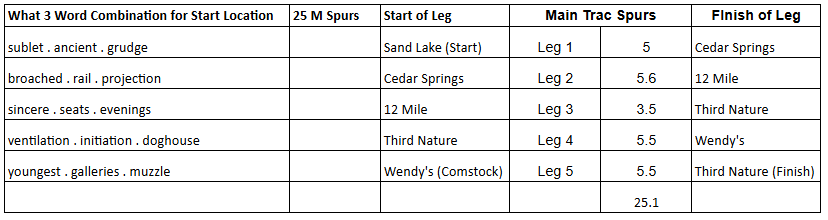
The FRED 25 Mile Reay: Includes 5 "spurs" or legs, from Sand Lake, past Third Nature Brewing, to Comstock and back to Third Nature. We are really flexible with how many people are on a team. Some will have one person who runs all 25 and some will have 5 or more members. We stay flexible, because this whole run is in the day light and a shorter distance. We want to keep it loose and fun.
100 Mile - Spur Location & Distance
The race begins in Cadillac Michigan, where teams will work together to cover miles south to Comstock Park, before the last leg, returning north to Third Nature Brewing. This 100 mile course is the second hundred, for the 200 mile, which is why the Spur count starts at 19 (of 36 total for the 200).
Because this chart is for the 200, please make note that the 100 starts at the north east side of Cadillac Lake, and works it's way up the list, with reference to Spur 19-36. Please note that in Reed City, there is a double out and back on the Pier Marquette Trail, starting from the same spot.

200 Mile - Spur Location & Distance
The 200 Mile Relay begins at Third Nature Brewing, running south to Belmont, before north to and around Lake Cadillac, and continuing back to the finish. Please note that Pierson, Reed City and Cadillac Lake are exchange spots, between vehicles.
Please note that in Reed City, there is a double out and back on the Pier Marquette Trail, starting from the same spot.

25 Mile - Spur Location & Distance
The race begins at the White Pine Trail Head, in Sand Lake Michigan, where teams will work together to cover miles south to Comstock Park, before the last leg, returning north to Third Nature Brewing.
50 Mile - Spur Location & Distance
The race begins in Big Rapids Michigan, where teams will work together to cover miles south to Belmont, before the last leg, returning north to Third Nature Brewing. This 50 mile course is the last quarter of the 200 mile, which is why the Spur count starts at 27 (of 36 total for the 200). On the chart below, start at Big Rapids Spur 27


Team Transportation
Regardless which distance, teams are responsible for their own transportation.
The event starts with one runner on the course and the remainder of the team will use at least one vehicle to transport to the next exchange zone. At each exchange zone, the active runner will join the vehicle and the next runner will begin the next leg of the relay. This continues until the team has covered the full distance of the event.
When a team is big enough to have TWO vehicles: Vehicle one does exactly as listed above, but vehicle two is free to go anywhere. For the 200 Mile Relay, there will be resting areas where we provide places to try sleep and have bathrooms. Just keep in mind that when the last person is done from a vehicle, the first person from the alternating vehicle must be there and ready to run.
Feel free to message us with any questions...
TEAMS
Train Glossary
TRAIN LINGO (Railroad Terminology)
Steam Locomotive
The locomotive is the essential part of a steam train. It’s the railroad vehicle that provides the force to move the train. A steam locomotive works by burning a combustible material (such as wood, coal, or oil) to heat water stored in the locomotive’s boiler and create steam. Once the water becomes gaseous, its pressure is used to propel the locomotive and any attached cars.
Parts of a Steam Train:
To get a better understanding of how a steam locomotive works, here are some of the major components.
Firebox: Where fuel is burned to generate heat.
Boiler: Hot gases produced in the firebox heat up water stored in the boiler through a rack of tubes.
Steam Dome: Steam collects in this dome at the top of the boiler.
Pistons: Propel the wheels using the force of high-pressure steam.
Smokebox: Hot exhaust collects in the smokebox to exit the locomotive
Stack: Spent steam from the smokebox exits the locomotive via the stack.
Cab: Where the train crew operates the locomotive.
Sand Dome: Contains sand that is deposited onto the rails in front of the driving wheels for traction.
Hostling
Hostling is the process of moving a locomotive to a ready track and preparing it for mechanical servicing. The “hostler” prepares the locomotive for operational service by ensuring adequate steam pressure and essential lubrication.
Engineer
A train engineer is responsible for driving the locomotive to its destination and adhering to the travel schedule. The engineer also monitors the steam pressure, fuel, and water in the locomotive.
Conductor
A conductor coordinates the daily activity of the train crew and passengers. They don’t operate the locomotive.
Locomotive Wheels
There are three types of wheels that support a locomotive: Driving wheels, leading wheels, and trailing wheels. Let’s look at the key differences between them.
Driving Wheels: The driving wheels support the weight of the locomotive and move it forward. They are powered by force generated from the steam engines.
Leading Wheels: The leading wheels are located in front of the driving wheels and are used to help the locomotive negotiate curves and support the front of the boiler.
Trailing Wheels: The trailing wheels are those located behind the driving wheels that support the crew cab and locomotive firebox.
Wheel Arrangement
A wheel arrangement, also referred to as a wheel configuration, is the system for classifying how the wheels are arranged under a locomotive. Depending on the country and type of locomotive, there are different notations to describe wheel arrangement. The Whyte notation is most commonly used for steam locomotive wheel arrangement. This system counts the number of leading wheels, then the number of driving wheels, and finally the number of trailing wheels, and separates them by dashes. For example, a steam locomotive with four leading wheels in front, then six driving wheels, and two trailing wheels would have a wheel arrangement that’s classified as 4-6-2 in Whyte notation.
Short Line Railroad
A short line railroad is a small railroad operation that runs over a relatively short distance. Most short line railroads serve a specific purpose within communities and industrial centers. The Strasburg Rail Road is the oldest continuously operating short line railroad in the United States. It connects the community of Strasburg across a 4.5-mile single stretch of track that ends at Amtrak’s main line.
Whistle
Although all riders enjoy the sound of the train whistle going off while they ride, it actually serves a much more important purpose than entertainment. The whistle on a steam locomotive is actually a signaling device that is used to warn individuals nearby that the train is approaching and communicate with rail workers. While there used to be many whistle signals used, there are only three that you’re likely to hear today:
Two long, one short, and one long whistle: This is a grade-crossing signal to warn employees or others on the tracks.
Two (or three) short whistles: This indicates that the engineer will be moving the train forward (or backward) momentarily.
One long blast: This signal is used when a train is approaching a station on a track that’s next to a platform.
Pilot/Cowcatcher
A pilot, also known as a cowcatcher, is a device that’s attached to the front of a locomotive to push obstacles off the track that could otherwise damage or derail the train. It also helps remove snow from the rails in colder climates.
Freight Train
A freight train, or cargo train, is used to transport goods or animals from place to place rather than human passengers. Shipping by train is often the most eco-friendly and affordable solution, especially for long distances. Freight trains can have up to six or seven locomotives, depending on the shipment size.
Passenger Train
A passenger train is a train that people use for traveling from one destination to another along a railroad line. Passenger trains typically have 1-2 locomotives.
Types of Train Cars
There are many different types of train cars, both for passengers and freight service. Here are six of the most common types of train cars and their definitions to help you tell the difference.
Passenger
A passenger car is used to transport people. These cars can be outfitted and configured in various ways, depending on the duration of the journey. For example, some can be designed for dining or sleeping accommodations.
Boxcar
A boxcar is a type of freight car that’s enclosed on all sides and features sliding doors. They can carry a variety of freight (most commonly boxed goods).
Flatcar
Flatcars are open, flatbed freight cars that are used to carry large, bulky freight that doesn’t fit in an enclosed freight car (such as large machinery or timber).
Hopper Car
Hopper cars are freight cars that transport loose or fine-grained bulk items such as coal, ore, sugar, and grains. Doors at the bottom of the car are opened to dump the cargo.
Gondola cars are similar to hopper cars in that they haul the same kind of materials, but they don’t have doors at the bottom. Some gondolas are designed with the ability to lean to the side to dump the loose cargo.
Stock Car
Stock cars are used to transport livestock. They’re specifically designed to keep the animals safe and with adequate food and water for the duration of the trip.
Caboose
The caboose is the final car on a freight train. It provides shelter for the crew members during the trip. Before the advancement of more advanced safety technology, the caboose was also used for observing problems at the rear of the train.
The FRED 25 Mile Relay
The 25 Mile Relay is a great introduction to relays. The course will include 5 suggested segments and will start in Sand Lake, on Saturday morning. Teams will progress to the first exchange zone in Cedar Springs, before continuing to the exchange, where the trail crosses 12 Mile rd. From there, you will progress to the Third Nature Brewing, where you will then continue south to roughly the Wendy's on West River, exchanging for the last time, before the last runner returns north to the finish line and party at Third Nature Brewing. Team sizes are definitely flexible, but the team must run the segments in progressing order and cover all 25 miles. Start times will be determined based on average pace of the team.
The FRED 25 Mile Relay - Highschool
Same as the Adult 25 Mile Relay, but the team must be fully composed of Highschool athletes.
The FRED 50 Mile Relay
- Team are made up of up to 11 participants.
- There are 11 relay Legs (spurs), collectively running from Big Rapids to Belmont.
- Each Team decides how to split up the relay Legs (spurs).
- Crew start times are based on the average pace starting on Friday morning and continuing non-stop until they finish!
The FRED 100 Mile Relay
- Teams are made of up to 6 participants.
- There are 18 relay Legs (spurs), collectively run from Cadillac to Belmont, starting at the Spur 19 location.
- Each Team decides how to split up the relay Legs (spurs).
- Crew start times are based on the average pace starting on Friday night and continuing non-stop until they finish!
The FRED 200 Mile Relay
- Team size options are 6 person, 9 person or 12 person
- There are 36 total relay Legs (spurs), collectively running from Belmont, to and around Lake Cadillac, and returning back to Belmont, with 18 Spurs north and 18 south. The 36 are broken into 6 segments of 6 spurs, 3 north and 3 back, allowing vehicles to alternate. See chart below.
- There will be designated resting / vehicle exchange areas are in Pierson, Reed City and Lake Cadillac. Teams can split runners into two vehicles, so only one vehicle has to be active on course at at time, allowing the non-active vehicle to rest.
- Crew start times are based on the average pace starting on Friday morning and continuing non-stop until they finish!

SWAG
Aside from the adventure, we all want good swag. Along with your registration you will receive an awesome shirt, finisher medal, complimentary food and drink ticket.
Post Event Food and Drink
As part of your registration, along with Third Nature Brewing, we will be offering 1 complimentary food and drink ticket for each participant.
Any additional food or drink may be purchased from the restaurant.
What3Words Location Marking
Here at The FRED, we use the website and app, What3Words to identify locations for starts and exchanges. This runs on the premise that every square meter on the planet Earth, has a unique three word identifier. The What3Words app pairs with both Google Maps and Apple Maps, to help guide you from your current location, to the entered three word identifier.
The referenced chart is for the whole 200 Mile Relay. The 100 starts at Spur 19 at Lake Cadillac and works its way back up the count to finish at Third Nature. The 50 Mile starts at Spur 27 in Big Rapids and also works it's way back up.


The White Pine Thaw Marathon Relay
The FRED Running Relay can be a challenge to some. We also put on The White Pine Thaw Marathon Relay, the second Sunday in March. This event starts in Comstock Park, right behind Vitale's. Teams averaging 6 runners, will start at 9am and run 13.1 miles north to Russell Road, before returning back. Suggested exchange zones will be in Belmont and Rockford, as well as the turn around at Russell Road. Following the team accomplishment, teams can gather inside of Vitale's where you can redeem the food and drink voucher that came with registration. This is DEFINITELY a great practice run for The FRED!
Facebook: https://www.facebook.com/profile.php?id=61553582861207
Here's the website for more details: https://runsignup.com/Race/MI/ComstockPark/WhitePineThawMarathonTeamRelay